
by Beth Primrose
Perhaps it’s just me. Perhaps I’m feeling a sense of cabin fever from being inside with the kids over the holidays and the stuffiness of the season of central heating, but Goldsworthy’s exhibition mostly made me feel like I wanted to leave. I craved fresh air and the crunch of leaves. I wanted to get out of the gallery and crack ice. I wanted to escape the masses and stifling chatter to fully appreciate this titan of sculpture at his best.
Maybe that’s the point? Maybe Goldsworthy wants to celebrate the outdoors and make us get outside. However, it didn’t feel like that was the point. I’m not even sure Goldsworthy knew what the point was either. A hint of contention between the artist and the gallery perhaps lie beneath this: discussing Skylight (2025) he explained that he, ‘hope[d] that the skylight would be cleaned to let light into the building and illuminate the work.’ And here in lies the contradiction and struggle between this kind of art and the institution: developed in the landscape to avoid the white cube and the capitalist trappings that came with it, land artists quickly realised that to live in a capitalist society they needed money and so started to present their work back in the settings they were initially trying to avoid. And as with all partnerships and compromises, this one comes with its flaws.
Whilst Goldsworthy’s dramatic and immersive works could be transformational, they instead feel staged and suffocated by the space and crowds gathered here. This felt especially true of the site-specific centrepiece, Oak Passageway (2025). The all-consuming vastness of nature one should feel at the scale of this corridor of fallen branches is completely subsumed by the obstacle course it becomes. Instead of feeling humanity’s smallness in the face of nature’s majesty we must contend with squeezing past the hordes of other guests. The piece becomes more like a fairground spectacle than the breath of fresh air it should be. Add to this the echoing acoustics of the space that detract so wildly from the feeling of nature that it’s hard to feel anything but stressed.
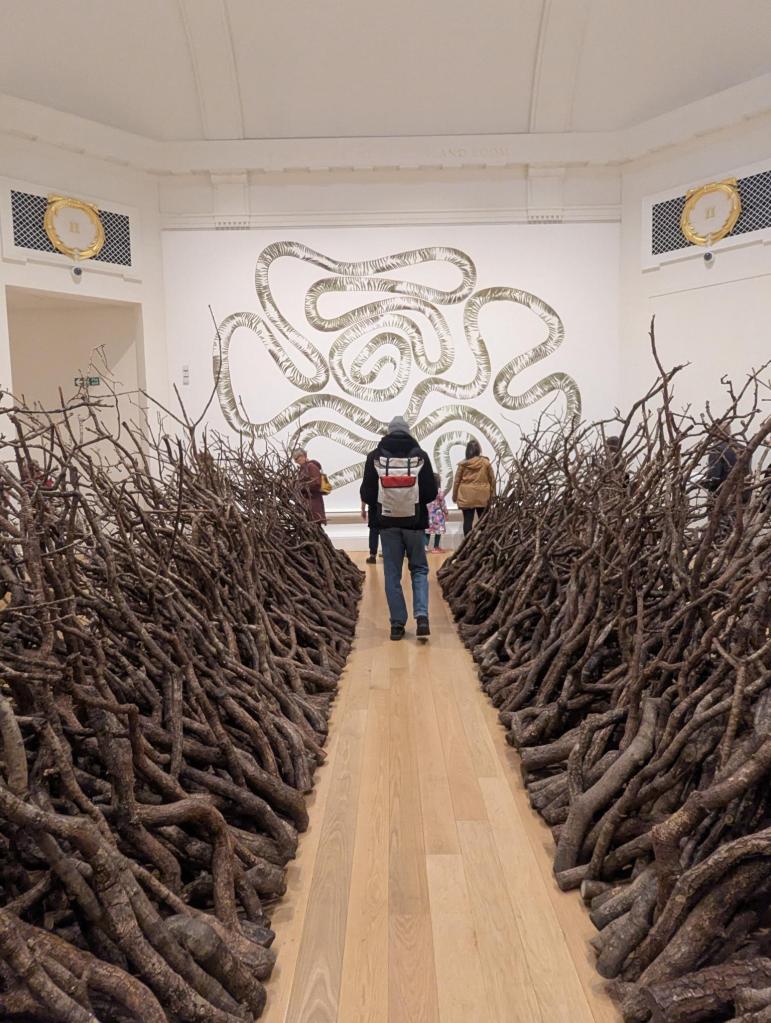
Image description: A passage of light oak floor is edged by dark and spindly oak branches. At the end of passage ferns decorate the wall in snaking circular patterns.
Heading through to the galleries at the rear of the building are a forest of photographs featuring felled logs glowing with embellishments of ochre leaves. Stunning lightning bolts of gorgeous burnt sienna trees are captured in dramatic setting but harsh lighting jars with these damp dark woody places and it’s hard not to question why the lighting used in Gravestones wasn’t also employed in these galleries. All the goodness one might feel from looking at these isolated and striking scenes is spoiled by the synthetic light and again, the intrusion of people.
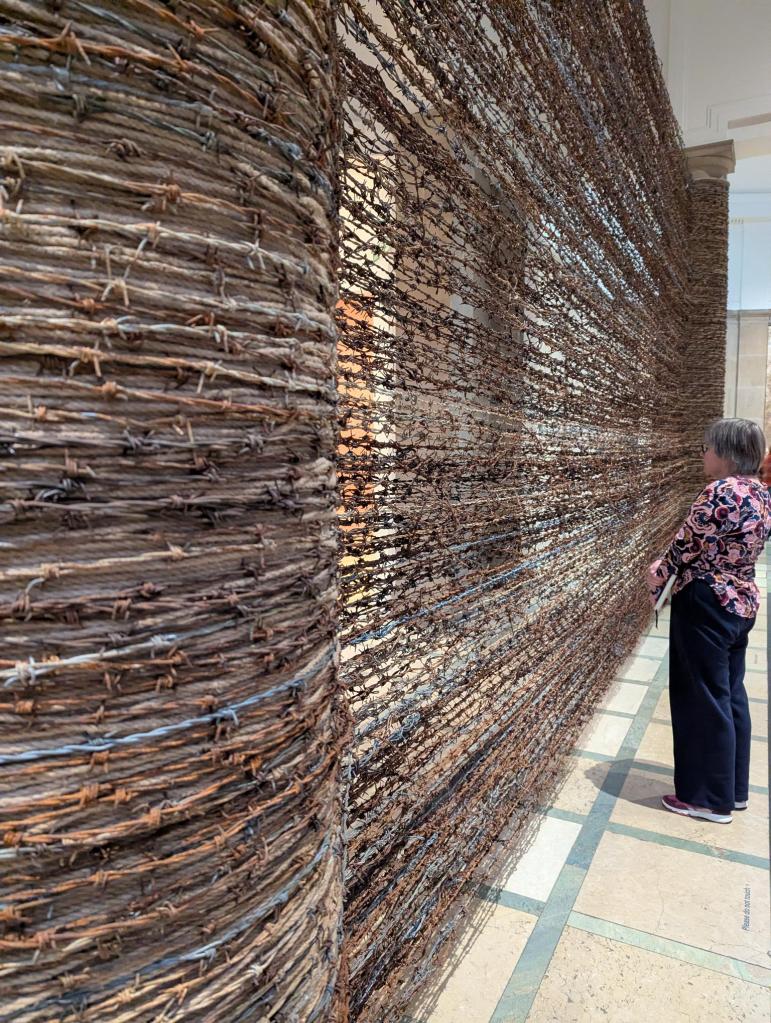
ID: a wall of rusted barbed wire is stretched between two stone columns.
I’m sorry Andy, but that’s not my only gripe either. After treading up dramatic fleece lined stairs we are confronted by a visceral wall of barbed wire, Fence (2025). Constructed between two colonial style pillars the exhibition text cites the literal fences and barriers thar Goldsworthy’s encounters whilst making his work as inspiration for the piece. To utilise a material synonymous with war, and pain, entrapment and suffering, in a time of war and pain and immense suffering and not draw parallels to this seemed tone deaf at best and just plain ignorant at worst. Famed critic, Jonathan Jones, wrote in the Guradian that the exhibition was “uncannily gripping”[1] and I’d agree but for me it was for the wrong reasons.
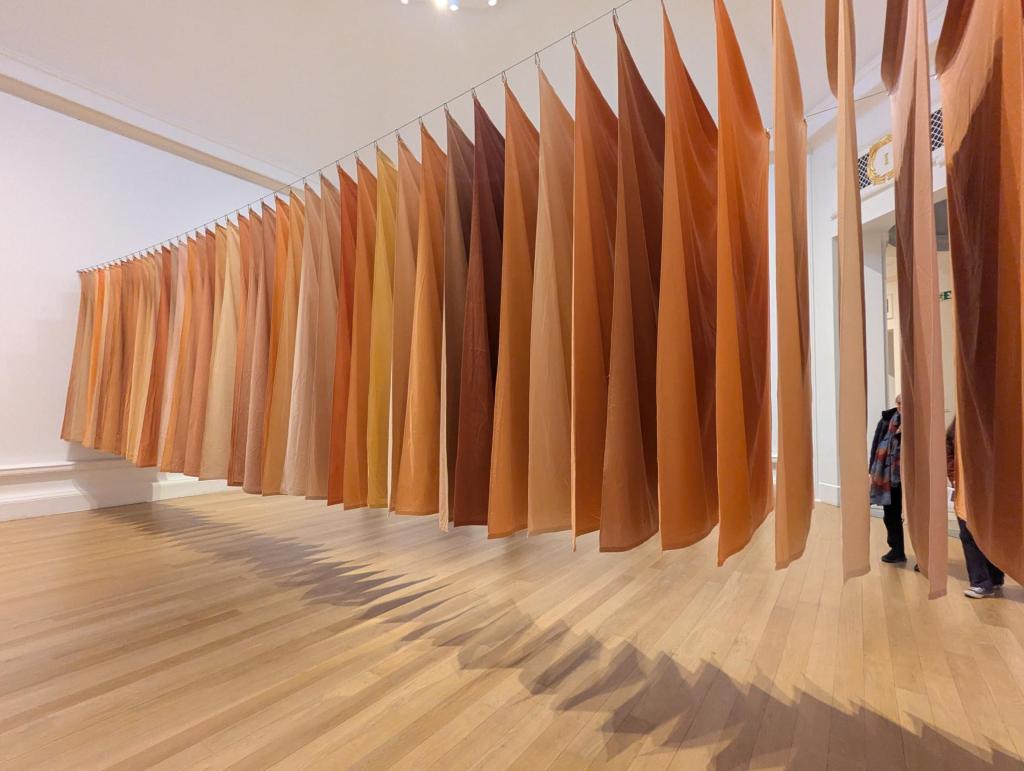
ID: a row of ‘flags’, in warm beige, yellows reds and burnt sienna colours, hang vertically across a gallery.
There were of course highlights- the minimalist view of Red Flags( 2020), dividing one of the main gallery spaces, was outstanding and seemed to hit on a deeper connection to earth and society which Fence (2025) missed. The flags, originally created for Frieze Sculpture, and hung at Rockefeller Center, are dyed with earth from each of the 50 states in America. The title alone speaks to the troublesome tension between land and capitalism and all the acrimonious, Colonial connotations that come with rubbing earth into a flag. The work- literally dividing the room- could also be read as a statement on America’s divisive leader and America’s world view which looms large over current politics. Choosing to hang the muted earthy flags horizontally, Goldsworthy seems to subtly conveys a head-hanging shame, disappointment and subversion of the stars and stripes MAGA that has become synonymous with Trumpism and right-wing populism.
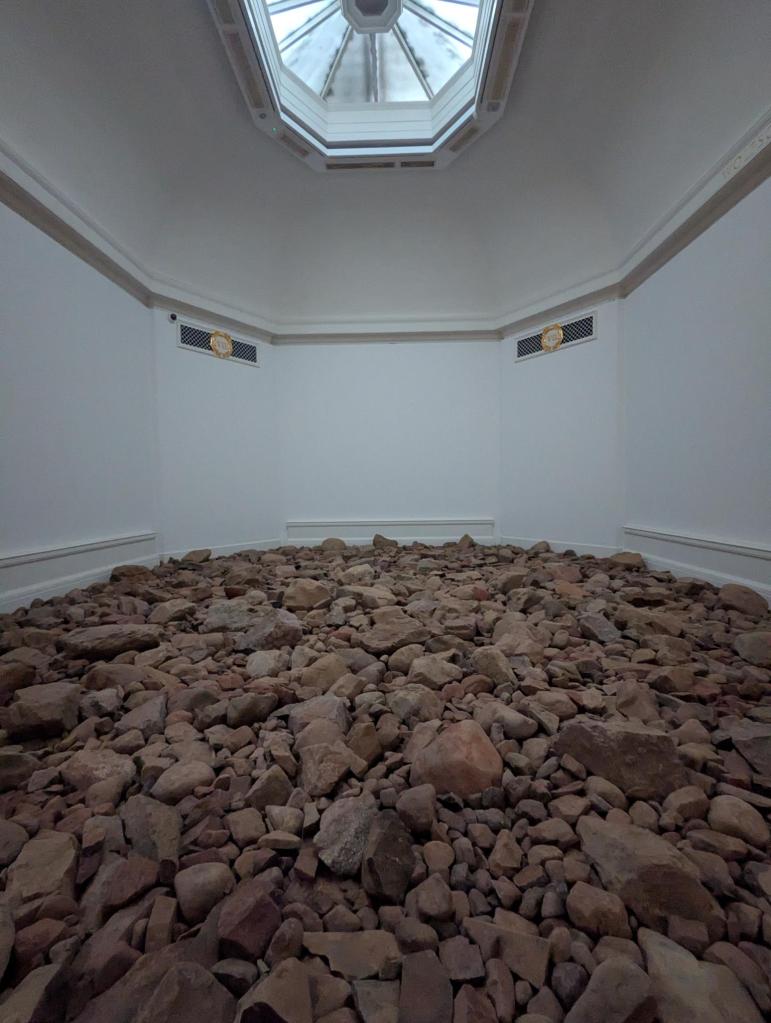
ID: A floor filled with a variety of sized stones, in a white gallery space with an octagonal skylight.
The vast landscape of Gravestones (2025) was also a considered and meditative work of introspection. A vast landscape, created with boulders recovered from graves dug across 108 graveyards, we can visualise the space these bodies now inhabit. The astute use of low lighting creates a gloaming where one can really ponder upon the idea of entropy. The immovable natural material being replaced by the organic human matter which will slowly become part of the earth points to our limited time on earth and feebleness in the face of these geological titans. The sharp border of the severed stones leaves us at a haunting precipice where we are left contemplating the border between this world and the afterlife.
Drawing from the iconic works of land artists in the 70s though there is a glaring sense of extraction in this work. In the presence of this imposing piece, the absence that has been left in the land is also stark, and is a reminder of both the artist’s and humanities impact on the environment. In this extraction Goldsworthy’s work is the antithesis of many land artist’s tenet ‘leave no trace’ and I wonder if it might leave some of them turning in their graves?
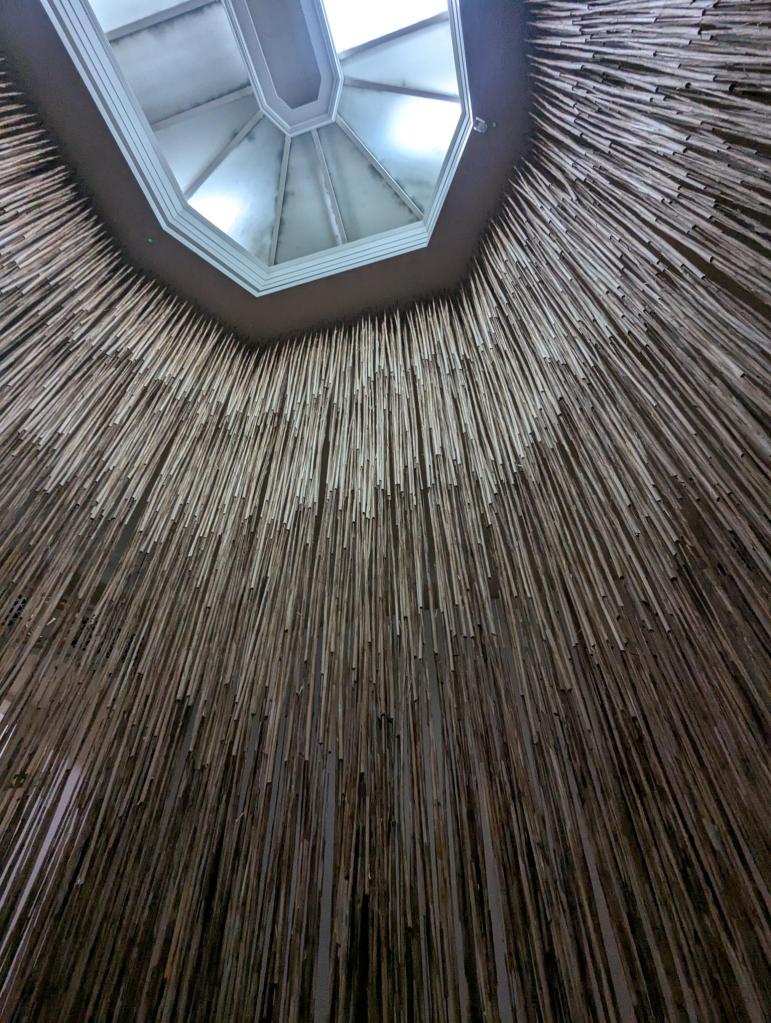
ID: an octagonal skylight is surrounded by curtains of bullrushes.
Skylight 2025, created as a partner to Gravestones, provides another space for tranquillity and meditation. Enveloped in swathes of interlocking bullrushes the installation seems to rain down and sway gently, all at once: disorientating in the best of senses, we can forget the crowds of shoppers on Princess Street and the gallery as we are subsumed by this ephemeral living being. Untouched by artificial lighting I was afforded a moments silent contemplation before being brought back down to earth by the lively chatter of a stream of visitors.
Included in the retrospective were many of Goldsworthy’s earlier works. Notably, Midsummer Snowballs 2000, speaks to a much lighter and experimental time in the artist’s practice where he transported awe-inspiring colossal snowballs into London’s financial district. Left for the public to interact with as they chose, these works were shifted by forklift trucks, anthropomorphised with giant eyes, blocked busy London roads and became visiting sites for gaggles of nursery children. Whilst humorous and engaging these works could also be read as something wholly more significant. The timing of this transient intervention- the longest day of the year and nature’s peak- was inevitably followed by the snowball’s demise. Placed in the financial district, were these icy totems a prophetic forewarning of climate catastrophe and the capitalist culture the city symbolises, the setting and catalyst for this doomsday prediction?
Midsummer Snowballs 2000, also highlights how differently people interact with these types of work outside of the gallery. They feel free to do what they will with it- touch it, lift it, embellish it- and this interaction and element of chance adds a different perspective, audience and outcome to the work which is smothered by gallery walls. Unlike many of the other works though, the presentation of these pieces were enhanced by the crowds at the gallery- the frozen spectacles were already surrounded with the hustle and bustle of the city and the audience simply become part of this.
Andy Goldsworthy: Fifty Years, is a tale of many settings, of spectacular and awe-inspiring landscapes; vast rocky terrains and contemplative spaces but also of a stifling and overcrowded gallery which suffocates some of the work and its potential. For me it was a tale of both success and disappointment. Of questioning works which challenge the status quo and immersive works which would have been infinitely more successful in a different setting. Perhaps in another 20 years we’ll be exploring a retrospective of Goldsworthy’s work in a setting where it can be fully appreciated? More work for Jupiter Artland or The Yorkshire Sculpture park, Andy?
[1] Jones, J (2025), The best art and photography of 2025 – from eye-boggling Bridget Riley to the Face’s riotous fashion, The Guardian. Available at:
https://www.theguardian.com/artanddesign/2025/dec/22/the-best-art-and-photography-of-2025 (viewed 23/12/2025
 CAPture Art Magazine